
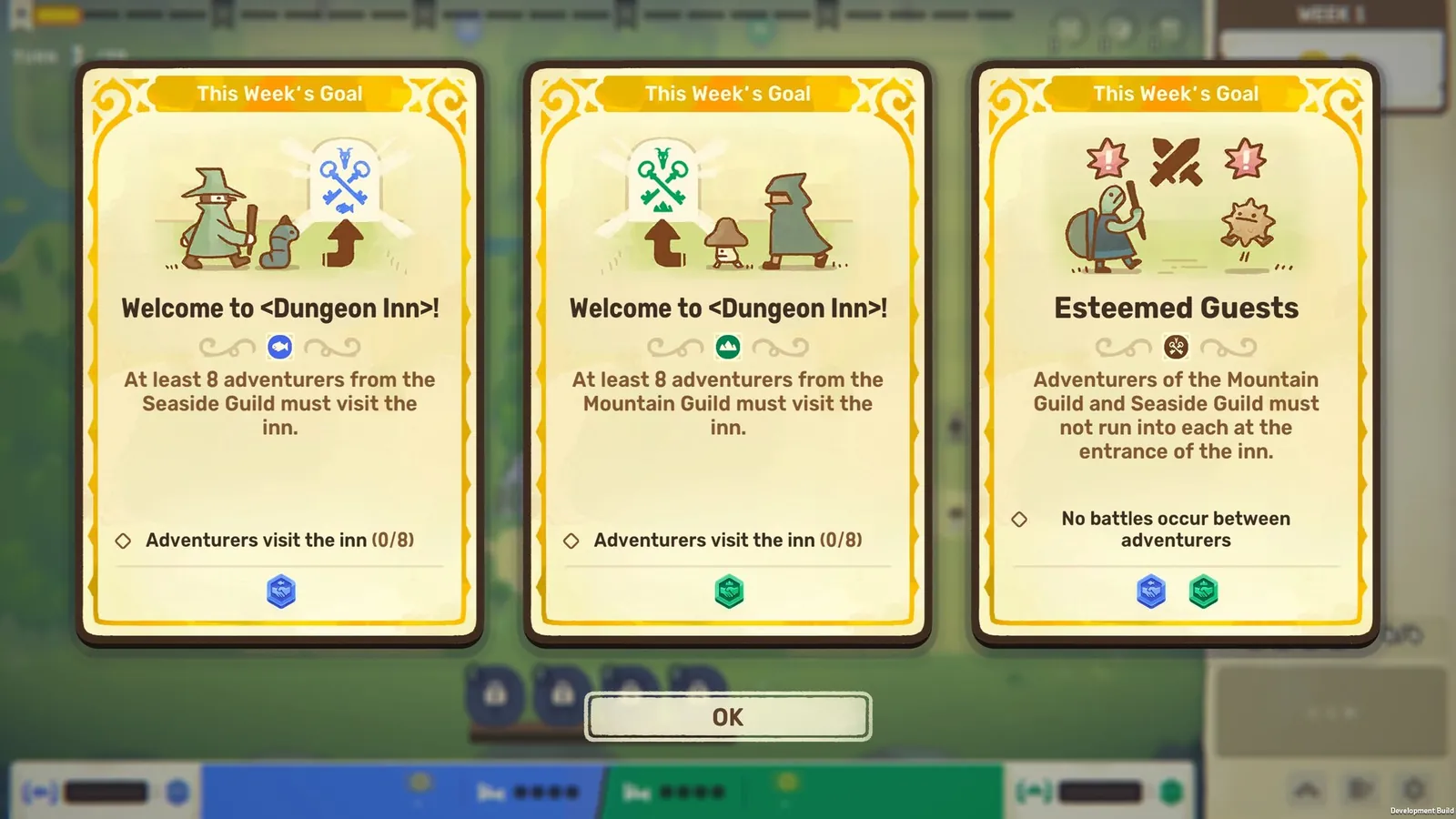
The story is not one long tutorial. Each block of chapters adds a system that changes what a good week looks like, and the chapters assume you already absorbed the previous one. Knowing the order is most of the preparation.
The campaign at a glance
| Item | What the game states |
|---|---|
| Chapters | 12 in total; 10-12 were added with 1.0 |
| Publisher estimate | Around 20 hours of Story Mode |
| Scoring inside a chapter | Weekly Goals, plus Monthly Goals that decide the chapter rank |
| Modes | Story Mode, plus Challenge Mode (the renamed Endless Mode) from the Extras menu |
| Continuity | Early Access saves carry over automatically |
Monthly Goals were added in the April 2025 update and apply to every chapter. They are separate from the weekly objectives: the week tells you what to do now, the month decides the rank you leave the chapter with.
How a chapter is actually scored
A chapter hands you Weekly Goals and then keeps a running monthly tally. The tally is what the game grades, so a week that clears its goals while burning a resource the month needs can still leave you with a worse rank than a slower week.
That is why the chapter map below lists mechanics rather than placements. The placement answer changes with your room layout and your token stock; the mechanic answer does not.
What each block of chapters adds
| Chapters | The new thing | What it changes in your week |
|---|---|---|
| 1-4 | The base loop, then the lobby | From chapter 2 the lobby sells Operation Know-how and Image Control with guild tokens; chapter 4 adds Dragon Token exchange |
| 5-6 | Chestnut Detective Chever and the summer heatwave | Sudden visits from a detective, and heat that makes wisps reluctant to work |
| 7-8 | Parties and the Flock effect | Groups must be housed together; Flock days flood the roads with departures |
| 9 | Companion skills and Suites | Bami’s Busker and May’s Cleanup arrive; the premium room tier appears |
| 10 | Winter and contraband | Snowdrifts and icy roads; Sara starts dealing contraband goods with Anise |
| 11 | The Blizzard | Coldness stacks, snowdrifts every turn, and an “avoid freezing” objective |
| 12 | The finale | The story closes; the systems you have been balancing all run at once |
Chapters 1 to 4: learn the two queues
The opening chapters are about the two roads, the two lodges and the goal sheet. Nothing in this block asks you to optimise; it asks you to notice.
Chapter 2 is the first real upgrade point. Operation Know-how turns the old automatic Fame bonuses into purchases, and Image Control moves into the lobby as a token-bought way to reduce Suspicion. Both are permanent tools for the rest of the game, so tokens spent here are not wasted — but tokens spent keeping a bar down are tokens not spent on beds.
Chapter 4 opens the Dragon Token exchange: a set number of tokens from each guild buys one Dragon Token. That single rule explains why a run that ignores one guild stalls later; the exchange needs both sides to have stock.
Chapters 5 and 6: the detective and the heat
Chever, the Chestnut Detective, drops in unannounced. The chapters are built around surviving those visits without letting the double business show.
The same update added the summer heatwave. Wisps are sensitive to heat and become reluctant to work, and adventurers are less willing to brave the roads. Practically, that means fewer placements per turn and a tighter budget on delays — the exact opposite of what a crowded week wants.
Chapters 7 to 9: parties, crowds and companions
Three systems land in a row, and they interact.
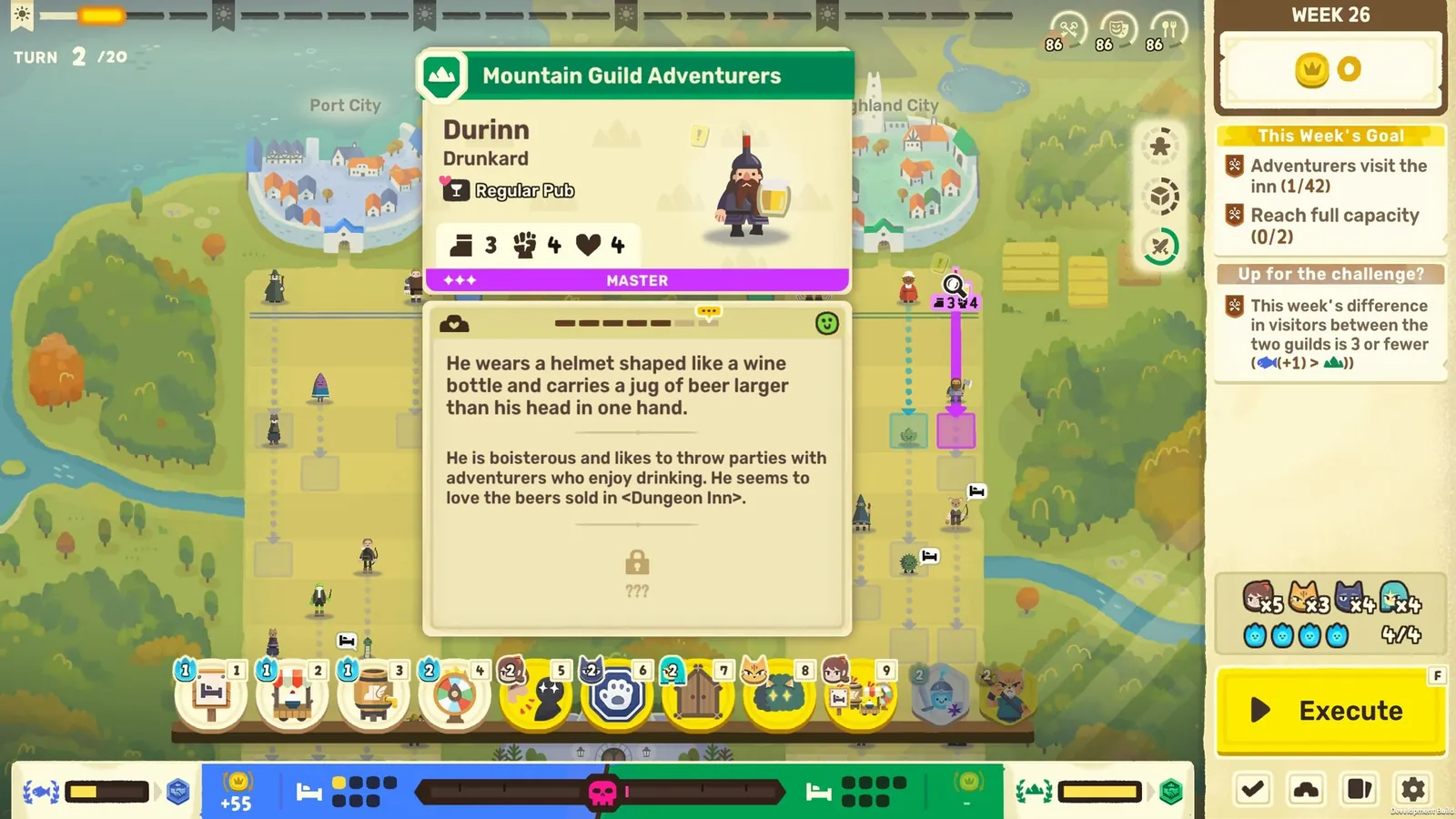
Parties of two or more adventurers arrive together. If one member falls behind, the others wait at the crossroads for the slowest traveller, and if the lodge cannot bed the whole group, the group leaves together. Timing tools now have to be aimed at the slowest member, not the nearest one.
The Flock effect is the opposite pressure: on a Flock day the number of adventurers leaving the city explodes, and the inn either absorbs the wave or watches it walk past.
Chapter 9 brings companion skills and the Suites. Bami’s Busker earns income and reputation through town performances; May’s Cleanup ends a front-door fight outright. The Suites are a premium tier for the few guests who can afford them — they do not fix a standard-room shortage, because most adventurers still prefer standard and deluxe rooms and will leave rather than take a suite.
Chapters 10 to 12: winter, contraband and the end
Chapter 10 moves the map into winter and starts the contraband line with Anise. Contraband can be sold to guests, including Mountain Guild adventurers, and it runs through to chapter 12.
Winter changes movement before it changes anything else. A snowdrift costs an extra movement point; an icy road pushes a traveller one extra space for free. Both appear on random rows and never on adjacent rows, so a pair you separated last turn can come back together after the tiles move.
Chapter 11 is the Blizzard. Each turn brings one or two snowdrifts and no icy roads; every adventurer outdoors gains a stack of Coldness at the start of the turn; five stacks without shelter is fatal. Adventurers with only two movement points do not spawn on blizzard days at all. The winter guide covers the details.
Chapter 12 closes the story. The developers said they wrote it backwards from the ending to avoid a forced finish; the mechanical consequence is that every system you have met is live at once.
After chapter 12
Challenge Mode, the mode that used to be called Endless Mode, sits under Extras. The 1.0 announcement describes it as extra management challenges beyond the story rather than a second campaign. Its dedicated page explains what the mode’s earlier update described and what the 1.0 notes do not restate.
Where this walkthrough stops
The released material explains mechanics, not placements. There is no published answer for “which device on which turn in week 23”, and the recorded 1.0 footage that exists does not cover the late chapters in a way that would let this site describe them honestly. If your week is stuck, the useful pages are the ones for guild arrivals, suspicion and winter — the three systems that decide most late-game weeks.