
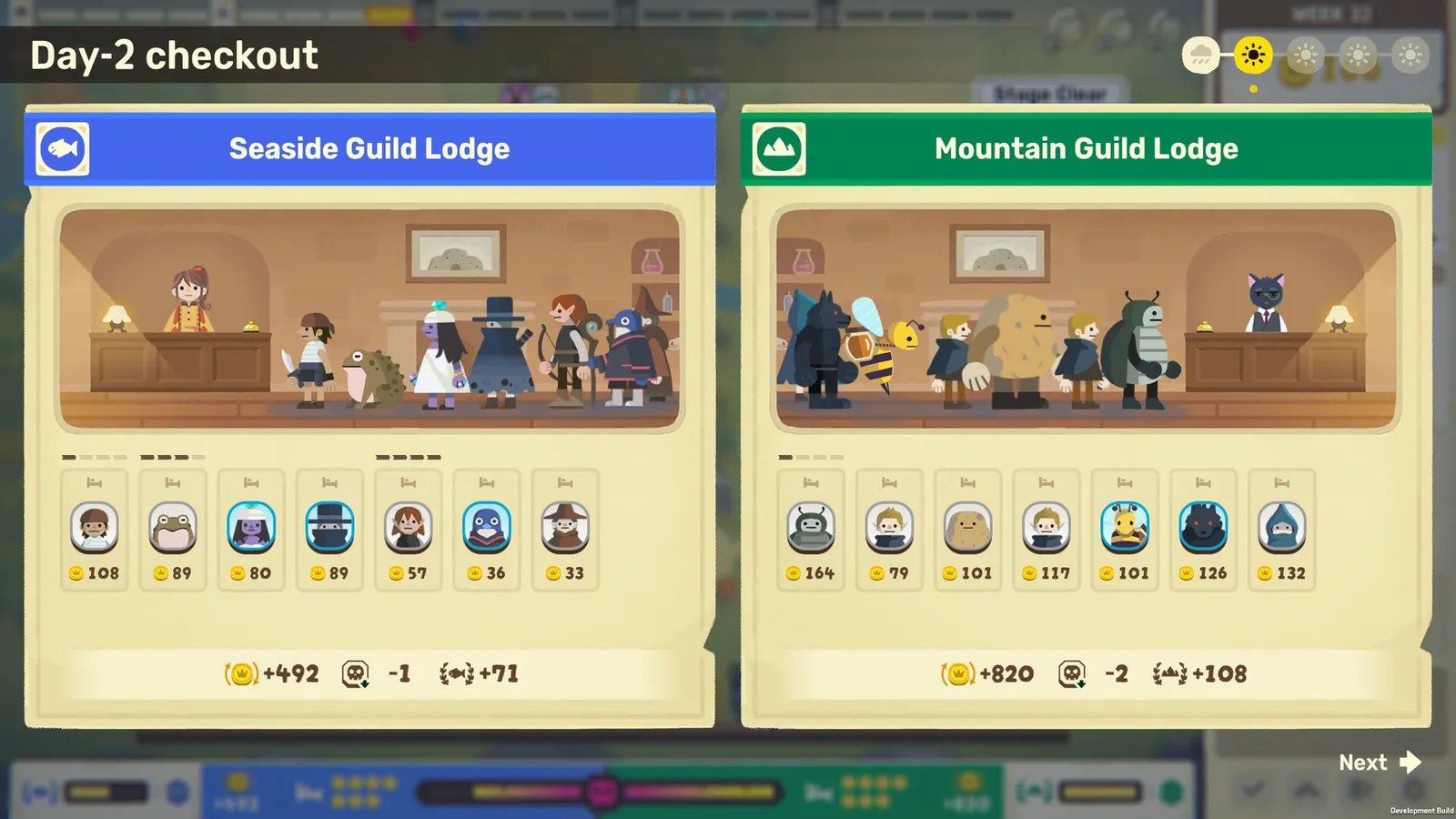
The game never asks you to pick a favourite guild. It asks you to keep two rival businesses profitable off the same road network while neither notices the other is staying. That is a scheduling problem wrapped in an accounting problem.
Two lodges that do not share anything
Each guild has its own lodge inside the inn, with its own bed count. A full lodge turns away its own guests for the day even when the other side has empty rooms.
This is the single most expensive misunderstanding in the early game. Players watch a queue build, assume the inn is full, and buy an upgrade on the wrong side. The rooms and facilities page explains what each tier is for; here the point is narrower: check the lodge, not the inn.
Tokens belong to the guild that issued them
Guild tokens are not a shared currency. The in-game note is explicit: a token from the same guild as the lodge must be used. Practically:
- Beds and facilities on the Mountain Guild side are bought with Mountain Guild tokens.
- The Seaside Guild lodge has its own stock and its own upgrades.
- The lobby is the exception — Operation Know-how and Image Control are bought with tokens and apply to the whole inn.
- From chapter 4, both guilds’ tokens feed the Dragon Token exchange, which needs stock from each side.
That last point is the balancing mechanism. A run that funnels everything into one guild eventually cannot buy Dragon Tokens, because the exchange wants both.
When they meet at the door
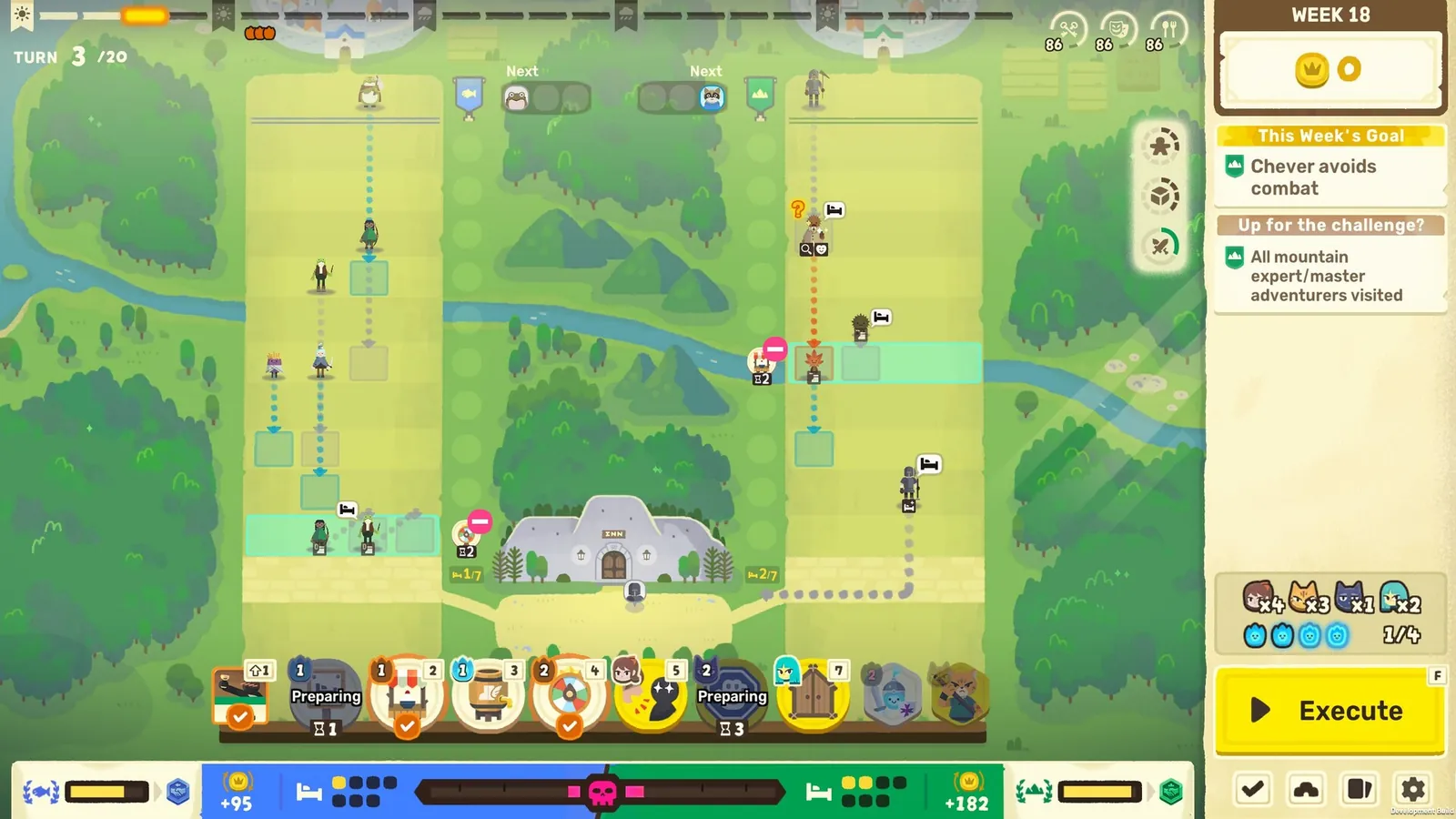
A fight starts when rival adventurers reach the entrance together. The prompt offers three responses, and they are not equivalent.
| Response | What it does | When it is the right call |
|---|---|---|
| Back one side with armored wisps | That side is more likely to win; winning lowers that side’s suspicion | When one bar is close to full and you can afford to pick a winner |
| Switch sides before confirming | Lets you back the other guild instead | When the weaker side is the one whose suspicion you need to drop |
| Stay out | Nobody is helped; the fight resolves | When both bars have room and you would rather keep the wisps |
Helping the weaker side is generally the better payout, because the swing is larger. The risk is losing: a losing intervention spends the wisps and leaves the bar where it was.
There is a second-order cost. Victory stories spread among the winners, and if the same story circulates often enough it becomes its own problem. Fighting less is a strategy, not a failure.
Suspicion is the real fail state
Each guild has its own bar. Either one filling ends the run for that attempt.
The mitigations are all deliberate:
- Image Control opens in the lobby from chapter 2 and spends guild tokens to bring suspicion down. In Early Access it was an in-stage purchase limited per chapter; in 1.0 it is a lobby decision, which means it competes with beds for the same tokens.
- Winning a fight you backed lowers that side’s suspicion. It is the cheapest way to buy room on a bar, provided you win.
- Volunteer work spends money to buy trust back. It is the option for a rich week with a nervous guild.
- Black market offers pay well and raise suspicion. They are the reverse trade.
Version 1.0 also caps the “Suspicion Increases Weekly” simple event at once per week — the 24 October 2026 hotfix changed that because players were being buried by repeated events. Before that patch, a bad week could stack the same event several times.
A failed week is not a failed chapter
When a bar fills, you can go back to an earlier day of the same week and try again. That is a retry, not a reset: the chapter’s earlier weeks stay done.
It changes how much a risky week costs. If the alternative to a fight is a coin-flip on the bar, the retry is cheap enough to take the fight and see.
What this page will not give you
There is no published week-by-week allocation table, and inventing one would be guesswork dressed as a schedule. What the evidence supports is the structure: two lodges, two token stocks, two bars, one door. Work from the goals on the week sheet and the nearest traveller on each road, and the allocation follows from those four facts.